
Bowling Built Community First. It Never Got the Credit.
There's a version of America that only exists inside a bowling alley now, and most people don't realize it's disappearing.
I'm Ryan, founder of SPARE/WARE, a bowling lifestyle apparel brand. And this is the case for why bowling built more of American community life than any other sport, gets zero credit for it, and why that legacy is closer to extinction than people think.
For most of the 20th century, the bowling alley was the third place. Not home, not work. The place in between, where leagues met on the same night every week, for years, sometimes decades. Where a weekday night team was as reliable as a job. Where kids sat in the plastic chairs behind the scoring table and grew up watching their parents show up for something, consistently, with people who weren't family.
That's not nostalgia. That's a developed community infrastructure. Bowling had it before anyone was writing think pieces about "third places" or worrying about the decline of social life.
In fact, when a Harvard political scientist needed one image to describe the collapse of that social life, he reached for bowling. "Bowling Alone" became the phrase for a country that stopped showing up to anything together. The book wasn't about bowling. It used bowling as the stand-in for every kind of community America was losing. That's how deep the sport was wired into the culture. It wasn't the subject. It was the model.
And bowling got nothing for it. No cultural credit. No reverence. Instead, the alley became the punchline, the sport became a game, a night out here, a birthday party there, and the leagues that used to anchor entire towns got written off as relics instead of recognized as the model everyone else is now trying to recreate.
Now compare that to what other sports get. A pickup basketball game gets treated as culture. A backyard football game gets treated as tradition. Pickleball was labeled as the future. But the weekly bowling league, the thing that actually kept people coming back to the same room, on the same night, for years, gets treated as a joke about ugly shoes, a pun about splits and gutters, and treated as less than by many.
Here's what nobody mentions: bowling was never a niche. It was mainstream before "mainstream" was ever defined or got redefined by whatever is trending. It had national television coverage. It had stars. It had Saturday afternoons built around it. It didn't fall out of culture because it stopped mattering. It fell out of culture because nobody kept building around it while everything else got a rebrand to keep up then get ahead.
That's the gap. Not a talent gap, not a participation gap. A respect gap. The sport did the work of holding communities together for generations and never got positioned as anything more than a hobby, more than a past time.
Bowling doesn't need a redemption arc. It needs someone to say what should have been said the whole time: this sport built the exact thing every other sport institution in America has or is trying to recreate for themselves. Consistent people, in a consistent place, intentionally showing up with the same goal and purpose, week in and out.
Here's what keeps me up at night about it. Bowling has always just been there. Reliable. Unbothered. Almost tucked away. The kind of thing you take for granted, the thing you assume will still be waiting for you on the next open evening, so nobody feels the urgency to protect it, let alone to grow it. But "always there" can never be a guarantee. Alleys close. Leagues thin out. Nobody notices the night it stopped being enough people to fill the lanes, they just notice one day that it's gone. Or worse, maybe they don't notice at all.
I don't have any illusions about being the one who saves the sport. I'm one person, with one brand, in one small corner of all of this. But every fire starts as a spark somebody was willing to be, and I'd rather be that than bear witness to watching it slip away into the dark. So this is me lighting the match. Bowling deserves the attention back. All I'm asking is that we don't wait until it's gone to admit that it always did.
This isn’t about apparel…
Because We're Not Just Bowling Apparel
There's a clear difference between wearing something because you're a bowler and wearing something because you're part of the culture.
Look around at a league night or a tournament. Most of what passes for apparel out there has been treated like an afterthought, a pin, a ball, a lane, a pun. It's built for people who already bowl, marketed as a hobby accessory, and worn the way you'd wear a work uniform: because it says what you do, and only where you do it.
What I'm Actually Building…
Bowling deserves the same cultural weight as any other major sport, the same real athletes, the same real stakes, the same real investment in what comes next. That belief is the whole company. Not a slogan bolted onto a t-shirt after the fact, but the reason the t-shirt exists.
I'm designing for the identity underneath it, the same instinct that makes someone put on a jersey for a team they've never played for, or wear a label because of what it stands for, not what it depicts.
That's a harder thing to build than merch. It doesn't happen because a shirt looks good. It happens because the brand behind it acts like it believes what it's selling — funding the next generation, backing the venues that built this sport's history, showing up for the community instead of just printing its name on a shirt.
The mission isn't decorative. I laid out exactly why it exists and where it was born in an earlier post. It's not a marketing hook we added after the fact, it's the mechanism that makes the culture claim honest instead of aspirational.
You can print a slogan on anything. You can only build a movement if the thing you're selling is actually doing the work the slogan describes.
The Test
Here's how I know the difference is real: if someone who's never bowled a single frame in their life would still want to wear it, because of what it says about how they see the sport, not because of what it says about their score, that's culture.
And it's happening. Slowly, but it's happening. Right now, 5% of our apparel is worn by people who don't actively bowl. I have to imagine that's more than any bowling jersey can say.
If a piece only makes sense to someone already inside the sport, I've built merch.
I'm not interested in merch, save that for the concerts and the arenas. This is for the lifestyle. This is for the culture.
MISSION ORIENTED
Early 2000’s. Brunswick Zone. Quartermania. Twenty-five cent games. Twenty-five cent shoes. That was the start of bowling for me.
I grew up lower middle class. Broken family. Dodging and adjusting to shifting priorities. If I wanted to do what my friends were doing, I paid for it myself. So… I started working at 14 years old, slinging fries for the golden arches. Just to try and keep up and have the same fun I witnessed my friends having.
Bowling was one of those fun moments. Hours spent working on the weekend meant dozens of games played on the weekdays with friends. We we’re just kids, having fun, getting “good” and dreaming of doing more with the sport.
Then we joined a Youth League. Got humbled fast, and hooked even faster. House balls. House shoes. We knew that wasn’t going to cut it.
It took me, what felt like, hundreds of hours of work to save up for my first ball, a Hammer Black Widow, the original. (I’m still looking for another one to put on the office wall someday) My parents nor could I afford afford my bowling shoes, so house shoes it was.
Saturday morning league and tournaments alike, I bowled in house shoes against kids who seemingly had it all. Never had to guess about what was in their bag, let alone if they could even show up. Meanwhile, I was learning to balance taking time off of work and how many hours did I need to work for the next dose of fun.
That shaped me in many ways. I took a lot of that pain and used it to fuel the man I have become today. But it also left a very deep, lasting, cut of “what if”… “What if I had the same coaching, the same equipment, the same access?”
So when SPARE/WARE was born, I knew it had to stand for something. To solve for something most others overlooked with me.
That gap is the reason the Youth Development Fund exists.
A portion of proceeds from SPARE/WARE sale goes toward covering the basics for kids who want in on this sport but are stuck outside, a ball, a pair of shoes, an entry fee, whatever the actual barrier is. Not scholarships for future pros. Just enough for a kid to show up and bowl.
Most of these kids won't go pro. They might not even bowl in college. Most will just be league bowlers who found something they love and kept coming back to it. That's the win. That's what growing the sport actually looks like, not a handful of tour stops, but a community of people who never stopped showing up.
If gear is the only thing standing between a kid and a lane, that shouldn't be the reason they walk away. I know, because it almost was for me.
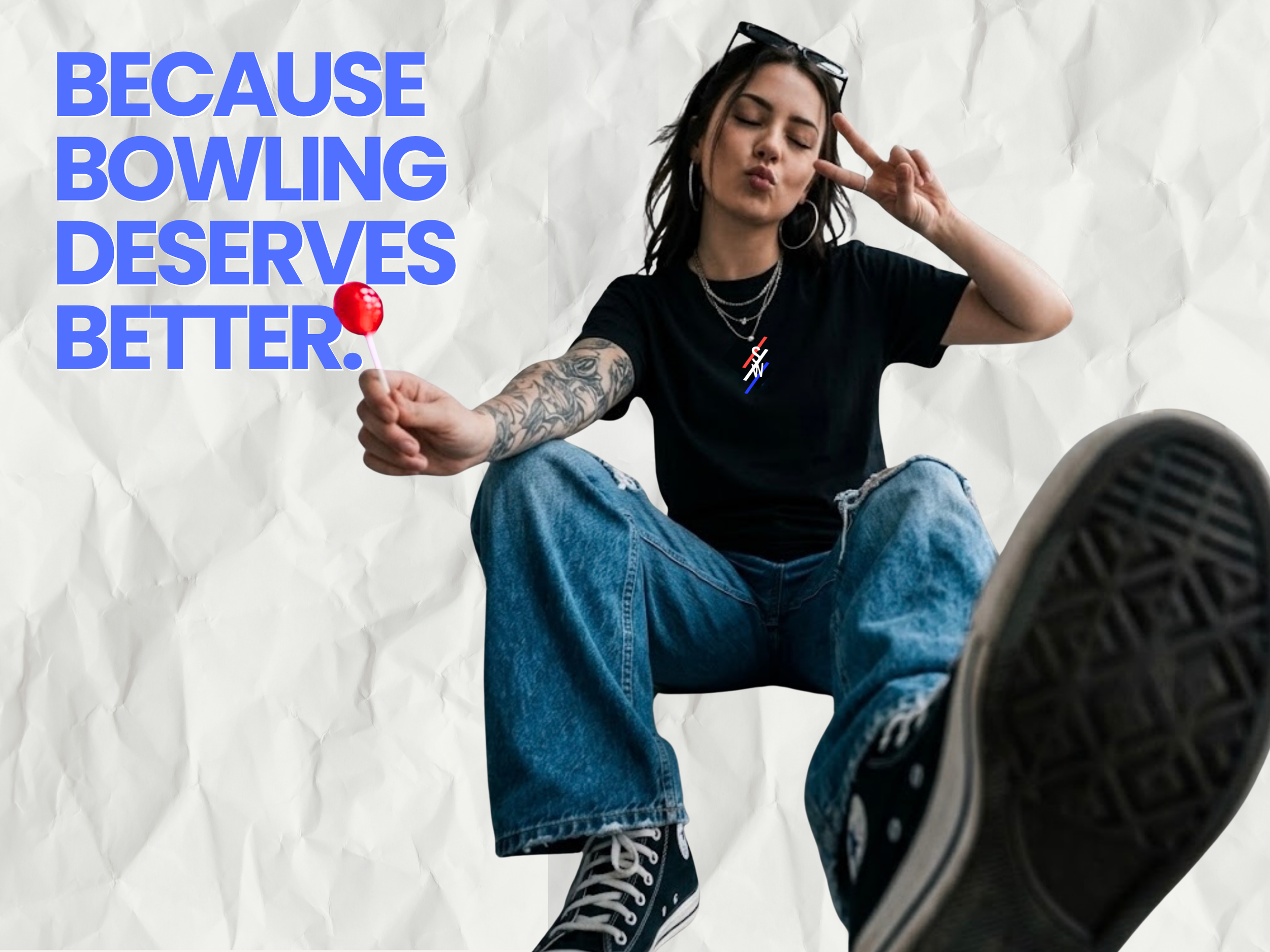
BECAUSE BOWLING DESERVES BETTER
Because Bowling Deserves Better. So that’s what were here to do.
Because Bowling Deserves Better. I have been hesitant to lead with that line. Not anymore.
SPARE/WARE is a bowling lifestyle brand. We make apparel built like the sport deserves it, and we put a portion of every sale into the next generation of bowlers coming up behind us.
Why SPARE/WARE?
Every other sport has a canon. Jerseys that mean something. Brands that treat the game like it matters. Bowling got left with novelty tees and league night leftovers, with modern "jerseys" riddled with AI images that exist for one purpose and disappear the moment you don't need them anymore. The sport lost its identity and its spark. It became the punchline to every other sport's joke.
SPARE/WARE exists to close that gap. Not with irony. With clothing built on real fabric, real construction, real intent.
Why Now?
Waiting for someone else to do it isn't a strategy. The lanes, the leagues, the next generation coming up behind them, they need investment now. Not a future version of respect everyone talks about and nobody delivers.
A portion of every sale goes to the Youth Development Fund. It covers the basics: balls, shoes, entry fees. The costs that decide whether a kid shows up or doesn't. It's not a footnote. It's the point.
Why Bowling Deserves Better?
Because the sport built community before "community" was a marketing word. Because it taught patience, precision, and how to lose a game with your name still on the scoresheet. Because integrity and hospitality aren't add-ons here, they're the rules of the house.